About Me

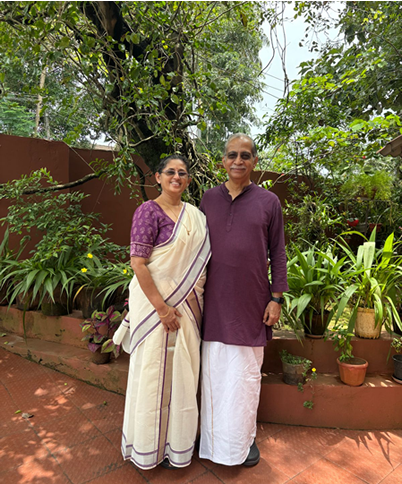
Devdas Menon

There are two ‘I’s, just as there are two ‘you’s, dear reader!

One is this apparent 'I', wrapped in a name, a form, and a personal story, moving through time and interacting with the apparent 'you' in this mysterious drama of life. A few fragments of my outer journey are shared through the links on this site. I have played various roles: a structural engineer, a professor, a consultant, and an author. Now, after retirement, I enjoy ‘sitting quietly, doing nothing’. I continue to write books (on finding fulfilment in life) and teach as a guest faculty at IIT Madras. I live in Chennai with my wife, Roshni, who teaches History at the school, Sishya.

But beyond this fleeting story abides the true I, which is also the true You: formless, timeless, transcendent, and indescribable.
Devdas Menon

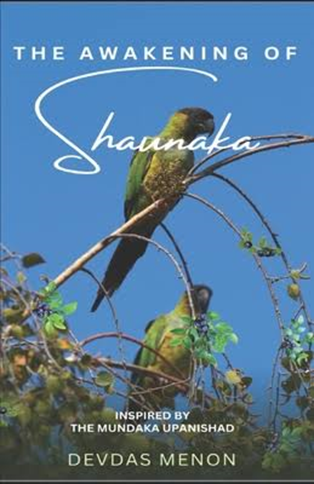
The two 'I's (or two 'you's) are symbolically depicted as two birds perched on the Tree of Life, as illustrated on the cover of my recent book. The lower bird - the apparent self - remains constantly occupied with worldly concerns and desires, eagerly consuming berries (some sweet, some bitter), and flying around restlessly. The higher bird - the True Self - watches the frantic activity of the lower bird, remaining still and serenely poised. Tired and frustrated, the lower bird may eventually notice the timeless presence of the higher bird and learn to live guided by its transcendent light, without 'doer-ship'. This is akin to the realisation that 'the kingdom of heaven is within you!'…


Select Review Comments

Dr A P J Abdul Kalam

Former President, Republic of India (review comments on the book "Stop Sleepwalking Through Life" By Devdas Menon)

I have studied the book and I liked particularly the chapter "The lightness of being" and the lines "Last but not the least is the big delusion ... that the ego-self is the 'doer'

Prof. N Rajagopalan

Retd. Professor, IIT Madras (comments on the book "Vidura's Mahabharata" By Devdas Menon)

I had the pleasure of reading the recent books titled Vidura's Mahabharata by Dr Devdas Menon, my former colleague of Civil Engineering Department. I have known him as an excellent teacher and knowledgable professor in Strutural Engineering. His books on the subject in that area are very good and excellently written, useful for Civil Engineers. After going through his present books on Spiritual topics, i have come to appreciate him as an evolved soul worth emulating. His books on Mahabharata are in 4 volumes.The first volume details out the Chandra Vamsa from King Yayati to King Shantanu to the Pandava-Kaurava rivalry. The second volume deals with the period up to Kuru Vamsa Mahabharata Yuddham, the third volume deals with the Yuddham inclusive of Bhghavat Gita, and the fourth volume deals with the after-effects of the war. The various chapters deal with the anecdotes and their significance to life, the difference between Dharmic life and Adharma, the causes and effects, appealing to all believers and also non-believers on faith and religion. The four categories of life not to be considered based on birth, but based on practices of profession, the four stages in one life, etc., and the understanding of Dharma depending on the time and situations are well explained through the words of Maharshi Vidura. There is so much to learn from all these expressions. I stongly reccomend reading this book by all. Dr Devdas has written four other books dealing with Upanishads which are also good literature to be read by all.

Achyuth Reddy, Hyderabad

Comments on the book "Vidura’s Mahabharata – Book 2: Preparations for War (2025)" By Devdas Menon

Book 2 covers the thirteen-year exile of the Pandavas and the attempts to reclaim their kingdom thereafter. The reader is rewarded with many nuggets along the way, not the least of which is the story of the Ramayana, which is narrated by Rishi Markandeya upon Yudhishthira’s request. The stories of Nala and Damayanti, Savitri and Yaksha Prashna are each an excellent rendering of parts of the Mahabharata that are not usually covered in the more commonly available condensed versions. The thirteenth year of exile, which the Pandavas had to spend in disguise, is captured in vivid detail, highlighting many interesting events. As it appears increasingly likely that war is inevitable, a despondent Dhritarashtra asks for Vidura’s counsel on morality and statecraft. Further questions on what death is, whether there is an afterlife, what moksha is, etc, are answered in the chapter "Vidura’s Niti and Sanatsujata’s Jnana". As always, the authors' simple, clear and engaging prose holds the reader's interest.

The book ends with the declaration of war after all peace efforts by elders like Bhishma, Vidura, and Drona fail. In what one may call - with a touch of irony - a last throw of the dice, Krishna himself is tasked with finding a peaceful resolution in accordance with dharma, but his attempt also proves futile. Whether it is destiny or the inexorable law of karma at work, everything leads ultimately to war on the battlefield of Kurukshetra.

Karthik Tiruvarur, USA

Comments on the book "Vidura’s Mahabharata – Book 3: War at Kurukshetra (2025)" By Devdas Menon

A large part of Book 3 is dedicated to one of the most significant occurrences on the Kurukshetra battlefield, the exchange of the Bhagavad Gita between Shri Krishna and Arjuna. Prof. Devdas' deep understanding of how a person can live to the fullest while performing the duties according to their prescribed Svadharma shines through his narration and his explanation of the Bhagavad Gita.

The 18 chapters of the Bhagavad Gita are explained in great detail, but also in a way that one can relate across different concepts that were introduced in Books I and II of the series. The Bhagavad Gita is often sometimes misunderstood as something very esoteric. Reading Prof. Devdas' version motivates one to look into the Bhagavad Gita as a deep exposition of understanding several fundamental concepts, such as causality, one's place in the universe as explained by Shri Krishna, and, more importantly, living a fulfilled life, a life that is aligned with one's own make-up, that is one's Svadharma. Prof. Devdas' life as a householder and a karma yogi is reflected in his understanding and explanation of the Bhagavad Gita.

Though I had read these concepts several times before, regarding the three gunas: rajas, tamas, and sattva, I feel I grasped them in totality for the first time only when I read these volumes on the Mahabharata, since they are presented in a very logical way, and you see them introduced and described across multiple characters and situations. I have been drawn to delve deeper into understanding Svadharma, what my own Svadharma is, and how one can align one’s life and work to live in accordance with Svadharma, ultimately living a fulfilled life.

P Harshavardhana, USA

Comments on the book "The Awakening of Shvetaketu (2023)" By Devdas Menon

This book is a masterpiece by Prof. Menon, who has distilled his experiential wisdom into words the uninitiated can appreciate. I have not read the Chandogya Upanishad, so I have no firsthand knowledge of it. I don’t know how simple or easy it is to understand, but I really doubt that it is as simple and lucid as Prof. Devdas Menon’s beautiful presentation in The Awakening of Shvetaketu. Prof. Menon brings his scientific and Engineering training to bear in conveying very effectively the reality of the That underlying the cosmic phantasmagoria that has us all in its thrall. This is a book written by an Engineer/Scientist for those with a similar bent of mind.

Here are the main takeaways I got from the book: 1)Anything which changes can only be an appearance; that which does not change alone can be reality, 2)There must of necessity be an unchanging reality underneath every appearance; That is the one unchanging reality that forms the essence of everything that is manifest, 3) Only in boundarylessness can the unheard be heard and the unknown be known; for a boundary implies there is something beyond with a separate reality, 4) Awareness of presence or presence of awareness are experienced in deep sleep and samadhi, and, 5) Changeless awareness is what makes possible the experience of all ever-changing appearances.

It is clear that Prof. Menon has reformulated his learnings from the ancient scriptures in terms of modern terms and concepts. For that I am grateful, for I, and most others, lack the mental model, and facility with the language, necessary to cognize the essential truths hidden in our scriptures. The Awakening of Shvetaketu has made it far easier to grasp the essence of That. To put it into practice and unlearn one’s ignorance is, however, a steep challenge, and each one of us must strive in our own unique way to make what progress we can. We are all Shvetaketus. Some of us are partially awake, some are in deep slumber, but we all need awakening. So rise, and read on, and be awakened!