Articles
Article List
Engineering Education: Training to Produce Technicians or Scientists?
This article was published in the Journal of Technical Education, ISTE, Vol.23, No. 1, pp. 38-43, January 2000.
Engineering professionals may be classified into two categories, Scientists and Technicians, depending on certain behavioural characteristics. Although both may possess high IQ, the Scientist is able to harness his energies far more creatively than the Technician is. The Scientist is intrinsically motivated, seeks to discover the true nature of physical reality, possesses a holistic outlook, and deeply enjoys his work. On the contrary, the Technician is deficiency-motivated, lacks the spirit of scientific enquiry, has a relatively narrow outlook, and is content with putting into application what is already known. This paper attempts to explore the main ingredients (such as enquiry, enjoyment, creativity and integrity) that make up the Scientist's temperament, and suggests that engineering education in general suffers for want of Scientists as educators. Examples are drawn from the fields of structural engineering and architecture, but the inferences are generalised enough to be extended to other engineering professions.
1. Introduction
There are, admittedly, shortcomings when it comes to classifying people (professionals, in this case) into two watertight compartments. But there are advantages in this simplification, and in this instance the merits of binary logic outweigh the shortcomings. In this paper, professionals (engineers, architects, etc.) are classified into two simple categories: Technicians and Scientists (Zukav 1980). Technicians constitute the run-of-the-mill category, whereas Scientists constitute the category of professionals of exceptionally high quality. Technicians, of course, constitute the majority; Scientists are a relatively rarer species. The behavioural differences between these two categories are markedly pronounced, and an understanding of these differences is important in the field of education.
What makes a Scientist so different from a Technician? Why are Scientists so few in number? What can we do in engineering education to increase their number (assuming, of course, that it is desirable to do so!)? This paper attempts to provide some answers to these basic questions, with specific reference to two professions, viz., structural engineering and architecture. The author's background as a teacher and consultant in the area of structural engineering is responsible for this limited focus. However, the observations and inferences made here are generalised enough, to be meaningful to other professions.
2. Scientist versus Technician
The terms, 'Scientist' and 'Technician', are described rather lucidly by Zukav (1980), with reference to physicists, as follows:
"When most people say, 'Scientist', they mean 'Technician'. A Technician is a highly trained person whose job is to apply known techniques and principles. He deals with the known. A Scientist is a person who seeks to know the true nature of physical reality. He deals with the unknown. In short, Scientists discover, and Technicians apply."
This interesting description, aimed at categorising physicists, may well be extended to engineers, architects and other professionals. The argument that engineering is an 'applied' science is of no relevance here, because there is tremendous scope for creativity even in the application of an applied science. Creativity implies innovation, and innovation in engineering demands a scientific temperament. Unfortunately, most engineers and architects are found wanting in scientific temperament. They are trained to do routine things, whose significance they neither realise nor question. They may be very intelligent, but their vision is narrow, and they fail to inject inspiration and enthusiasm in their work naturally. These are the Technicians. One can see them everywhere.
Scientists, on the other hand, are a relatively rare species, amongst engineers as well as architects. It is their basic nature not to take things for granted. They question, probe, discover and create. Their creativity may take physical form, or may be in the form of original concepts. They are driven by some peculiar intrinsic motivation, which injects a dynamic dimension to all their activities. Their range of vision is broad, generally transcending their fields of specialisation. They are able to discover, synthesise and manifest in their own lives, a harmony between Art and Science, and between theory and practice.
3. Architect-Engineer Interaction
3.1 Technician Level
Much is said and lamented about the mutual conflicts that engage architects and structural engineers during the course of their interaction. In the consultancy business, architects and engineers generally tend to view each other with suspicion, and, at times, with condescension. More often than not, this occurs when the engineers lack 'architectural sense', and when the architects lack 'engineering sense'. In the eyes of the Technician-engineer, the architect is a fanciful dreamer, who likes to build castles in the air, and is far removed from reality. The Technician-architect, on the other hand, views his counterpart as being grossly unimaginative, devoid of aesthetic sense, and prone to the use of defensive technical jargon when he fails to deliver the goods. The result of their interaction is a compromise (invariably, more in favour of the engineer than the architect), and is arrived at after much wrangling.
This architect-engineer conflict has been cogently expressed by the famous 'shell builder', Felix Candela, as follows (Faber 1960):
"The architect wants to maintain his preconceived ideas, but has no weapons to fight against the scientific arguments of the engineer. A dialogue is impossible between two people who speak different languages. The result of the struggle is generally the same: science prevails, and the final design has generally lost the eventual charm and fitness of detail dreamed by the architect."
3.2 Scientist Level
It is only the Scientist-engineer who can share the dream of the Scientist-architect, and so succeed in accomplishing it. Both are conscious and appreciative of the importance of teamwork and symbiotic activity. They are aware of the limitations in vision imposed by their respective areas of specialisation, and hence realise the complementary nature of their activities. Unlike the Technician-engineer, the Scientist-engineer is inwardly grateful to the architect for the challenges posed by him. The challenge is viewed not as a threat, but as a welcome opportunity. Similarly, unlike the Technician-architect, the Scientist-architect looks forward to his interaction with the engineer as a means towards improving his design. Such an architect has a relatively open mind, realises the significance of structure in architecture (Salvadori 1986), and seeks to capitalise on the creative skills of his counterpart. Indeed, many an architectural masterpiece is also a structural one; the structure is one with the architecture.
In short, architects and engineers may seem to be poles apart, but fundamentally, they have much in common in terms of their basic mentality. They are either Technicians or Scientists, and Technicians and Scientists are the ones who can be said to be poles apart!
4. Mediocrity in Technical Education
What makes an architect or an engineer? A technical qualification in the form of a degree certificate. It is tacitly assumed that the four or five years of academic experience in a technical institute do the needful in preparing a student in architecture and engineering. The underlying assumption is that passing examinations in various subjects is an adequate measure of one's professional competence. Hence, success in examinations is viewed as a necessary and sufficient condition for recruitment to various positions, particularly in the Government service.
The examination system, therefore, assumes awesome importance in society as a whole, particularly in today's highly competitive 'rat race' set-up. Students, teachers, parents, the Government - all are apparently overpowered and brainwashed by its import. Hence, it is but natural that the process of learning and teaching in many educational institutions becomes geared mainly towards exam-oriented instruction.
The ensuing result is a vast and overwhelming ocean of mediocrity - mediocrity in instruction, mediocrity in research, mediocrity in planning and design, and mediocrity in execution. The emphasis is on quantity, not quality; on Technicians, not Scientists. This problem is particularly severe in developing countries, which are struggling to keep abreast of the more developed nations.
The problem gets magnified over the years by the rapidly increasing 'information explosion', which results in an overloading of the curriculum to accommodate more and more information. As the pressure on the student builds up, survival demands that he be more selective and more exam-oriented in his learning, in order to beat the system. The student thus ends up becoming more mediocre. It's a vicious circle!
Nevertheless, there are exceptional individuals, who, by virtue of their intrinsic nature, do not fall into the rut of mediocrity. These are the budding Scientists, who are able to transcend the pitfalls of the socio-educational system. But the vast majority of students not only lack the qualities to react positively against mediocrity, but are, in fact, quite content to swim with the current. These are the Technicians - a self-propagating species.
Technicians have their place in any profession, no doubt. But it does not speak well of the health of any profession, if Technicians masquerade as Scientists and occupy key positions for which they basically lack competence. This is unfortunately the situation in many organisations, especially the ones in the public sector. Most thinking people cannot help but be conscious of this problem; but only a few of them are sensitive enough to do something about it in their own organisations.
Scientists alone are capable of perpetuating their unique culture. Under their inspiring influence, even Technicians undergo some transformation and are able to awaken and discover 'Scientist' faculties that lie latent in them. Every Scientist, therefore, is a born teacher. His teaching may not be deliberate; it operates as an invisible, but powerful, influence.
The scientific temperament is potentially latent in every intelligent individual, and can be awakened in a conducive environment. It is evidently the function of the educational system to provide and nurture such an environment; but this is sadly lacking in most educational institutions, which inadvertently encourage mediocrity. Unless otherwise inspired, the student is bound to be cast in the Technician mould, and to transmit this conditioning to his profession and to the environment.
To achieve excellence in technical education, and to avoid mediocrity, we obviously need Scientists as teachers. The so-called 'teacher-training' programmes operate under the assumption that existing Technician-teachers can be trained to improve their performance. Perhaps, they can; but not to such an extent as to transform themselves into Scientist-teachers. The scientific temperament needs to be awakened early in life; this cannot be done late in life.
5. Awakening the Scientific Temperament
The peculiarity of the scientific temperament is that it cannot be forcibly induced; it requires to be spontaneously activated. Hence, the verb 'awakening' is appropriate here, rather than 'cultivating' or 'attaining'. The individual must discover an aptitude for a profession that he has either consciously chosen, or which somehow has been thrust on him. Aptitude implies (i) a basic liking, plus (ii) an inherent ability. If either of these two components is missing, then the process of education becomes burdensome. If both components are missing, then it can be quite a torture! Faced with the latter situation, the sensible course of action would be to quit, and find an alternative occupation - ideally, for which one has a natural calling. As the Nobel Laureate, Isidor Rabi puts it: "It's too hard, and life too short, to spend your time doing something because somebody else has said it's important. You must feel the thing yourself..."
The ability of students to score good grades, and their liking to do so, do not necessarily reflect good aptitude. Often, it is a mere reflection of their basic intelligence, coupled with a motivation driven by competition. Aptitude has nothing to do with competition; it must flourish even in the absence of competition, and will do so only if the student basically enjoys what he is doing.
Awakening the scientific temperament is all about (1) encouraging the spirit of enquiry, (2) transmitting enjoyment, (3) stimulating creativity, (4) enhancing sensitivity and intuition, (5) inspiring integrity, and (6) inspiring motivation. Let us examine each of these components in some detail.
1. Enquiry
Problem-solving and decision-making are the two basic skills required of any professional. However, these skills differ significantly, both in degree and kind, in Scientists and Technicians.
The Scientist's approach to a problem (any problem) is based on the question 'Why?', whereas the Technician's approach to the same problem is based on the question 'How?'. The Technician is concerned about how to solve the problem, whereas the Scientist is keen on understanding why it is a problem in the first place. To the Scientist, the problem is something interesting that needs to be addressed fundamentally (and often, immediately). To the Technician, the problem is something bothersome that needs to be got rid of (unless, perhaps, there is an economic consideration involved!).
In short, the spirit of scientific enquiry is lacking in the Technician. Hence, his solutions are bound to be second-hand and routine, devoid of originality and creative content. This approach is usually an outcome of a training (a bad habit, one might say) imbibed during the course of one's formal education. It becomes difficult to get rid of this conditioning and to be able to arouse the spirit of enquiry later in life.
Structural design, for example, is taught in engineering schools, with reference to codes (standards). However, the codes are not meant to be used as a substitute for basic understanding and engineering judgement. The student must learn to question codes - as indeed, he must, nearly everything in life! (Pillai and Menon 1998). Unfortunately, the Technician-designer falls prey to the all-too-common habit of blindly following codes. Similarly, blind application of conventional methods of analysis and blind use of software packages, without understanding their bases, can sometimes lead to error and catastrophe. The mere fact that a structure is standing (i.e., not yet collapsed) is not always a testimony of structural engineering skills. Indeed, many structures stand, not because of good engineering, but in spite of bad engineering.
Interestingly enough, every individual would have experienced the spirit of scientific enquiry during early childhood. How spontaneously children pose questions about things that they do not understand, but are eager to! With the passage of years, however, they become more and more restrained and inhibited in their questioning - partly because a positive response is not always forthcoming, and partly because of a growing sense of self-consciousness. The loss of the freedom to question psychologically conditions the student, represses his enquiry, blunts his intellect, and prevents the full and free blossoming of his personality.
Under this situation, what is the role of the teacher in awakening the student? Zukav (1980) gives us a wonderful example:
"A Master teaches essence. When the essence is perceived, he teaches what is necessary to expand the perception. The Master does not speak of gravity until the student stands in wonder at the flower petal falling to the ground. He does not speak of mathematics until the student says, 'There must be a way to express this more simply'. In short, the Master does not teach, but the student learns."
This ideal style of teaching may not be easily practicable in the present-day system of formal education, due to the severe constraints involved in conveying a large volume of information within a limited period to a large number of students. However, it is still within the teacher's capacity to kindle interest in the student, and to de-condition his 'set' mind. For this, the teacher himself may have to pre-empt and pose questions, rather than wait for the stimulus to emerge from the students. Despite the constraints, the Scientist-teacher remains a Master, and functions in his own creative style. True, he may not succeed in covering fully the prescribed syllabus, but he may well succeed in uncovering it! He realises that the curriculum is essentially a vehicle to awaken the latent intellectual faculties in the student, and not an end in itself. The emphasis is on how to teach, not what to teach; on self-discovery, not spoon-feeding; and on long-term benefits, not short-term goals.
2. Enjoyment
The spirit of scientific enquiry is usually coupled with a sense of intense enjoyment. There is a joy in finding answers to one's questions, and more so, if this is achieved by dint of one's own effort.
There is another kind of joy associated, not with the process of learning, but with the process of doing - the so-called job satisfaction. Many people do experience such joy occasionally, if not periodically. Scientists, unlike Technicians, experience such joy so frequently, that it becomes a part of their nature. It is not the kind of joy that comes to us when we make money or when we achieve fame. It is a very private kind of joy that does not depend on others. But it is a joy that could possibly be transmitted to others, as happens when one encounters a Scientist-teacher. On the contrary, a Technician-teacher is one whose classes are likely to be dull and boring, precisely because he has failed to discover the joy in what he is teaching.
Is one able to enjoy the process of learning, the process of teaching, the process of working in one's profession for no ostensible reason - not for marks or money or status, but simply, for the sheer joy and beauty in it? There has to be something intrinsic in the profession to sustain one's interest and enjoyment; otherwise, one would easily tire of it. This suggests that there must be something new in it every time one looks at one's work. The discovery of 'newness', again and again, engenders creativity.
3. Creativity
Creativity is the most striking and illuminating characteristic of Scientists. Some psychologists define creativity as a product of fluency, flexibility and originality. Therefore, mere creation (such as the construction of structures) does not necessarily indicate creativity - especially if it is routine, unoriginal, or simply new for the sake of novelty. A creative solution must be appropriate and relevant to its context.
It appears that there is more scope and greater need for creativity in architecture than in structural engineering; but this is not necessarily so. It is perhaps more accurate to say that it is easier for an architect to express his creativity than it is for an engineer. The engineering profession, being so demanding in terms of safety and economy, tends to restrict avenues for innovation and experimentation. Technician-engineers find themselves so bound by codes and specifications that they use these as a pretext to rationalise their second-hand, stereotyped designs and construction practices. The Scientist-engineers, on the other hand, make their own rules and have their own unique ways of solving design problems, having well grasped the limitations and assumptions underlying accepted knowledge.
This probably explains why creative people are found to be highly intelligent. However, it is noteworthy that there are so many Technicians who possess high IQs, and yet lack creative imagination. Bound as they are by timidity, conventionality, anxiety and fear, they confine their energies to imitating, polishing, rearranging and generally tinkering around with what is already known. In contrast, Scientists are not only not threatened by the unknown, but they also relish its ambiguity, newness and mystery.
4. Sensitivity and Intuition
Sensitivity is a subtle and significant dimension of the mentality of the Scientist. It denotes a feeling of fine-tuning in a specific direction, leading to some kind of resonance. This resonance is usually accompanied by a feeling of wonder and joy. In the words of Einstein, "The most beautiful thing we can experience is the mysterious; it is the source of all art and science."
Scientists periodically experience this almost mystic feeling of wonder. Technicians, on the other hand, rarely have such experiences.
The 'aesthetic' sense is the most appropriate expression of sensitivity. Many people believe that this is an important requirement in architects. Clients often demand an 'exciting elevation' from the architect, without quite knowing what it means! The aesthetic sense does not relate to the visual beauty of some elements, but the beauty in the concept as a whole. It is derived from an experience of order and wholeness. Hence, even a simple mathematical equation can be the source of profound and delightful experience to one who is sensitive to its meaning. The Scientist makes a great and inspiring teacher if he is able to convey his insight to his students.
'Structural sense' is an expression of sensitivity familiar to Scientist-engineers. It establishes a direct experience of the load-transfer mechanism, and of the relative stability, strength and stiffness of the structure. It is an experience that usually precedes, and sometimes follows, mathematical calculations, and provides a necessary bridge between quantitative and qualitative knowledge. Technician-engineers mostly lack this 'feel' for structure, although they may have expertise in accurately analysing large and complex structures, and in calculating stresses and displacements to the nth degree of accuracy.
Sensitivity not only gives the satisfaction of perceiving the truth, but it also serves as a warning bell when something is seen out of place. The range of sensitivity may extend, in structural engineering, to areas such as sensitivity to detailing, sensitivity to economy, and sensitivity to ease in construction.
Sensitivity is the forerunner of intuition; only sensitive people can be intuitive. Intuition is a kind of sixth sense that immediately perceives the truth of things without reasoning and analysis. It has a peculiar strength to stand on its own, without the prop of accepted convention or bookish knowledge. No doubt, considerable sensitive experiences are required to enable the full awakening of intuition, which results from a synthesis of various sense perceptions.
The word 'intuition' has been much used in connection with Felix Candela. As Candela himself puts it (Faber 1960):
"It is always simple to explain the way you have done things after you have done them; but in many cases, such explanations are untrue, because one does not know exactly how one reached a certain point in one's thinking. When it comes to be explained, it can be seen clearly as a whole; the logical process is always an afterthought."
Intuition is too subtle and abstract a phenomenon to be communicated. Unlike sensitivity, it cannot be consciously awakened. However, one who has trained oneself regularly to be sensitive, is very likely to receive intuition.
5. Integrity
The scientific temperament of an individual is in many ways linked to his moral character. The Scientist is basically a truth-seeker. The importance of realising the truth, of getting to the bottom of things, is self-evident to him. Therefore, it is his basic nature not only to be intellectually honest, but also to reform and adapt in the light of the perceived truth. This implies mental alertness, sensitivity and perception to a degree well beyond the range of the unreflecting Technician mind. In later years, the Scientist's search for truth is likely to spill over to 'eternal questions', that are ordinarily described as ethical or philosophical.
The term 'integrity' is appropriate here, as we seek to describe a character of incorruptible quality and a vision that is holistic. Integrity is, admittedly, a scarce commodity in the present-day world. Corruption has infected society like a cancerous growth, and formal education has done little to check its damaging influence. Of course, sermonising on 'professional ethics' and 'professional commitment' is in vogue, but that has not really helped. There is often a hollowness in these terms, and one is reminded of the poetic words of T.S. Eliot: "We are the hollow men, we are the stuffed men, leaning together, headpiece filled with straw".
The Scientist, with his holistic vision, realises that ethics is a matter of inner realisation, and not adherence to external norms. Personal ethics must precede, and so be compatible with, the so-called 'professional ethics'.
However, we must recognise that most professionals are Technicians, not Scientists, and therefore emphasis on professional ethics is relevant and meaningful in today's context.
Ethics must somehow find a place (informal) in one's formal education. Integrity is naturally revealed in the teacher to the extent he has it and sees its importance. It is the Scientist-teacher alone who is capable of awakening and kindling a passion for truth-seeking in students, by integrating these thought processes with the spirit of scientific enquiry.
6. Motivation
Enquiry, enjoyment, creativity, sensitivity, intuition and integrity - these are seen to be the main ingredients of the scientific temperament. They are all inter-related, and come into synthesised being when certain energies are directed towards them. How are these energies harnessed in a Scientist, and why is this not possible in a Technician?
These pertinent questions are addressed by the psychologist, Abraham Maslow, in his famous theory of motivation based on need-gratification. According to Maslow (1970), "Healthy people are so different from average ones, not only in degree but in kind as well, that they generate two different kinds of psychology. The motivation of ordinary men is a striving for the basic need gratification that they lack. But for healthy people, motivation is just character growth, expression and maturation; in a word, 'self-actualisation'."
Scientists, as described in this paper, would well qualify to belong to Maslow's category of 'healthy people'; Technicians are the 'average ones', driven by the basic needs of security, money, status and power. Technicians need incentives to generate work; they are 'deficiency-motivated'. Scientists, on the other hand, are intrinsically motivated, or, to use Maslow's expression, 'growth-motivated'; they cannot help growing and maturing, rather effortlessly. They represent a high state of human evolution, where truth is sought for the sake of truth, knowledge for the sake of knowledge, and art for the sake of art. Technicians have neither the powers of concentration of Scientists nor their capacity to enjoy their work, because much of their mental energies are dissipated by their own personal pettiness and other distractions.
It is the task of the educationist to enable students to discover themselves, their needs and their potentialities. The scientific temperament in the 'have-nots' can be awakened, not by always doling out incentives, but by enabling them to recognise, accept and fulfil their inherent deficiencies.
6. Conclusions
An attempt has been made here to understand the qualities that distinguish high-quality engineering professionals from the mediocre ones. The terms, Scientists and Technicians have been used to describe the two categories. The presence or absence of a scientific temperament determines whether these professionals are Scientists or Technicians. Characteristics such as scientific enquiry, enjoyment, creativity, sensitivity, intuition, integrity and motivation make the difference between the Scientist and the Technician. Unfortunately, these are aspects that are often overlooked by engineering educators.
If the meaning of education is the full and free blossoming of the individual, and the wholesome realisation of the individual's potentialities, then Scientists can be said to be properly educated. Technicians, on the other hand, are not properly educated because they have not realised their full potential.
It is evident that our engineering education system suffers for want of Scientists as teachers. In the face of an overwhelming demand for engineering education in India, and the widespread mushrooming of engineering colleges, we end up sacrificing quality for the sake of quantity. We obviously need to ensure that we have more of Scientists as faculty in our engineering colleges.
References
- Faber, Colin (1960). Candela, the Shell Builder. Architectural Press, London.
- Maslow, Abraham (1970), Motivation and Personality. Harper and Row, New York.
- Pillai, S.U. and Menon, Devdas (1998). Reinforced Concrete Design. Tata McGraw-Hill, New Delhi
- Salvadori, Mario (1986). Structure in Architecture. Prentice Hall, Englewood Cliffs, New Jersey, third edition.
- Zukav, Gary (1980). The Dancing Wu Li Masters. Bantam Books Inc., New York.
Perspectives in Engineering Education
Text of an invited keynote paper at a Short-term course on Engineering Education, held at REC Calicut in December 2000
INTRODUCTION
Most of us are inclined to believing that there is something special about 'engineering education' that makes it different from (and perhaps superior to) other fields of education. This is largely a myth, and prevents us from viewing education in its proper overall perspective. Fundamentally, engineering education is not different from other education, whether related to pure sciences, medicine or even humanities. The emphasis should be on 'education'. This article, addressed primarily to engineering college teachers, attempts to focus on this overall perspective, which appears to have got lost in modern technical education.
Teachers teach, and thereby students learn, in general, in bits and pieces. Understanding each bit in itself is no trivial matter (depending largely on the competence of the teacher). As for the 'whole', it is but scarcely perceived in the pursuit of the parts. The teacher, as a course instructor, has a challenging task in emphasising the relative importance of the various parts, in integrating these parts, and in relating theory with practice. A greater challenge lies in relating and integrating the contents of a specific course with other courses in the engineering curriculum, and possibly with other disciplines as well. Perhaps the greatest challenge to the teacher arises from the recognition that education means much more than course instruction, and that being a good human being is no less important than being a good engineer.
To what extent the teacher seeks to respond to the above challenges depends entirely on the teacher's perspective. We generally assume that our mandate is limited to course instruction. Even if this were to be true, not many succeed in living up to this limited mandate. We often may succeed in covering the syllabus, but not quite in 'uncovering' it. For, in the attempt to 'uncover' the syllabus, we discover at times that we ourselves are in need of improved clarity of understanding, and that the students do not have the pre-requisite background in terms of concepts. We are therefore required to explore and navigate, not only within the confines of the prescribed syllabus, but also beyond its domain. In this creative process, we are bound to enter uncharted waters, and although this can be daunting, it offers the delight of discovery and breaks the monotony of the set pattern of teaching (which we are well accustomed to). Thus, no matter how many times a teacher is required to teach a particular course, there will be always something new to discover both in the subject and in the students, and the classroom interaction can be an educational experience not only for the students but also for the teacher. The wider the teacher's perspective, the more meaningful will this education be.
THE MEANING OF PERSPECTIVE IN EDUCATION
It is desirable that as engineering teachers, we attempt to perceive the 'whole' in education. This should enable us to see things in the proper perspective. The word 'perspective' means (in the present context) 'a way of judging the relative importance of things'. If this judgement is blurred or the perspective limited (as is usually the case), then the emphasis on the 'things' to be learnt gets misplaced. Consequently, the students are not enabled to discriminate between 'fundamental' knowledge (which constitutes the essence) and 'secondary' knowledge (general information and applications based on the essence). The need to have this discrimination becomes all the more important in the present context of the so-called 'knowledge explosion'. The sense of discrimination is particularly relevant in the prevailing job scenario, which finds the majority of our engineering graduates migrating from core engineering to software and management.
What students need to succeed in their careers, apparently, is not increased quantity of information, but increased quality of knowledge, coupled with analytical skills, decision-making abilities and communication skills. The engineering curriculum should therefore be viewed as a means for achieving these ends. This would be a desirable perspective for us teachers to have. But even this perspective would be restrictive, as it omits a vital component in education.
THE MISSING PERSPECTIVE IN MODERN EDUCATION
Knowledge and skills alone do not suffice. The third vital component in education, well-known in pedagogical theory (and conspicuous by its absence in pedagogical practice) is 'attitudes'. It is the total neglect of this vital component in our education system that is responsible for many of the ills in society.
The more 'educated' and 'successful' we become, the more conceited, self-centred, materialistic, pretentious and dishonest we also seem to become. This is the irony underlying our modern education system. And the tragedy lies in the fact that we all blame this on the 'system'. As teachers (especially teachers of engineering), we do not perceive that we constitute a major component of this system, and must therefore share some of the blame. The loss in status of the teaching community may be directly attributed to this. Yet, we conveniently ignore this problem, even at the highest policy making levels.
PERSPECTIVE AND RESPONSIBILITY
Widening our window of perception (or, expanding our perspective), we see what really needs to be done: not to be done by others (in the 'system'), but by us as individual teachers. We respond to this increased awareness, by exploring and experimenting, in our own individual and creative ways. The ability to respond effectively to a challenging situation is the original meaning of the word 'responsibility'. We need to take some responsibility for the condition of the student and for the direction he or she is heading, and we should take absolute responsibility for our own behaviour and actions.
Thus, perspective in education, for a teacher, is intimately related to responsibility. The larger the perspective, the greater the responsibility, which also means the greater our ability to respond to our perspective. It should be intuitively obvious to us that we cannot expect our students to have high quality education, unless we ourselves put into practice, in our own lives, such education. We cannot expect students to have clarity in perception as well as character, if we ourselves lack that clarity and character, but have pretensions to both. Improving our insight in knowledge (technical or otherwise) and improving our character are lifelong tasks. The former is something that we should naturally enjoy doing as academicians, while the latter is related to our 'samskaras' (for want of a better word).
MODERN TRENDS: A PARADIGM SHIFT IN PERSPECTIVE?
Following the trends in the Western world, technical education experts and policy makers in India, now herald a changing perspective in education. There is a call for a 'paradigm shift' in the role of the teacher: "from merely teaching to motivating and facilitating students to learn". In view of the booming 'knowledge explosion', and advancements in the 'means and techniques of acquiring knowledge', it is felt that the traditional lecture-based method of teaching students in a classroom is becoming obsolete. The modern age is one of 'web-based learning' and 'distance education', where education can be made accessible to all, and where there is no teacher, but plenty of learning resource materials. Even in the conventional classroom setting, the teacher is to realise that he or she is but one among many alternative resources, which include virtual libraries, video films, compact discs and slide projections.
The paradigm shift, in summary, is from teacher-centred instruction to student-centred learning.
One wonders, in the Indian context, whether this really signals any fundamental change in perspective. Has not engineering education for the vast majority of our students (in increasingly proliferating institutions) always been, in a sense, student-centred, or rather, examination-centred? To address this question, we need to shift our perspective from the 'ideal' of the policy planner to the ground reality that is not very flattering.
BITTER TRUTHS OF A NARROW PERSPECTIVE
Many of us, who have been taking courses at the post-graduate level in institutions such as the IITs, have often wondered as to how B.Tech. students with mediocre calibre make it to the top in their respective colleges, and also in the GATE exam. Some of the toppers in GATE reveal that they have achieved success through sheer hard work and self-study. Had they been exposed to good teaching, surely they would have performed even better, and in the bargain, would have a much deeper understanding of the subjects.
Our students are quick to realise that 'success' in engineering education lies essentially in beating the examination system, with or without the help of the teacher. Success is measured in terms of marks scored, and the clever student is one who anticipates questions correctly and gives the right answers. In recognition of this, a large number of examination-oriented textbooks have come into being, and enjoy immense popularity, both with students and teachers. There may be good textbooks available, with emphasis on the learning of fundamental concepts, but students do not generally have the time (nor the inclination) to study these books. Teachers too often have little exposure beyond the 'cookbook' textbooks. Question paper setters in various Universities also find it very convenient to pick questions (often verbatim) from such books.
It is a bitter truth, but we must face it. For the majority of us in this country, the perspective of education is indeed very narrow. The 'successful' amongst us are those who have tasted the joy of scoring high marks, not necessarily the joy of learning and gaining insights. Learning is frequently reduced to an exercise in remembrance, a short-term retention of information and the application of standard problem-solving techniques for the sole purpose of answering predictable questions in examinations. Those who succeed in this exercise may end up as teachers, soon after acquiring their degrees with distinction. Unless the new teachers, with the above background, reorient their perspective and devote their energies towards relearning the right way (and unlearning the wrong way), the situation in education can only be expected to get worse.
The basic premise made in the paradigm shift, that our course instruction is 'teacher-centred', is a far cry from reality. Our students know that they have to fend for themselves, and in this respect, their learning has been largely 'student-centred'. More accurately, it has been, and continues to be 'examination-centred'. If, the examination questions were to be more probing in nature, and more imaginative, testing depth of understanding rather than memory, things could perhaps be a lot different. But we have few people who have the capability and the willingness to devote the energy to set such questions. Besides, one can well anticipate all kinds of problems, with complaints not only from students, but also from teachers.
Admittedly, learning of some sort does take place even in the prevailing bleak scenario. However, it is qualitatively deficient, and leaves much to be desired. Any student who has had the fortune of being exposed to a master-teacher will immediately know the enormity of the difference. For the rest, it is the story of the proverbial 'frog in the well'. These are rather unflattering remarks to make of our country, proud as we are in being producers of the largest technical manpower in the world. The emphasis seems to be on quantity, rather than on quality.
Our real problem in engineering education is not only examination-oriented instruction, but also sub-standard teaching. Bad teachers do considerable damage. Students complain of how they have lost interest in a basic subject (and thereby, in all the subsequent related courses) because of the poor, indifferent (and, in some cases, offensive) manner in which it was taught. Students complain of how they have stopped asking questions, after receiving indifferent or intimidating responses from their teachers.
In the light of the above, the concept of 'student-centred learning' is no doubt desirable, but the emphasis should be on in-depth learning. It matters little, whether the student learns from a teacher, a textbook, a video film or a web-based source, provided the student really learns. This is possible only if the resources for learning (including the teacher) are of high quality. Asking our present teachers to change their roles from 'merely teaching' (which probably means teaching badly) to 'motivating and facilitating students to learn' is like placing the cart before the horse. For indeed, is not the expected outcome of good teaching precisely this: 'motivating and facilitating students to learn'?
In order to motivate and inspire students and enable them to have a broad perspective, the teacher must in the first place be motivated and inspired and have such a perspective. Herein lies the root of our problems.
THE MASTER-TEACHER: A MULTI-DIMENSIONAL PERSPECTIVE
"The bad teacher complains.
The good teacher explains.
The master-teacher inspires."
-Anonymous
In his fascinating treatise on modern physics, ("The Dancing Wu Li Masters"), Gary Zukav makes a very perceptive remark: "The master does not teach, but the student learns". With this student-centred concept of teaching in mind, he adds: "A master teaches essence. When the essence is perceived, he teaches what is necessary to expand the perception". Elsewhere in the book, Zukav comments that the teaching style of the master is like dancing. As the master 'dances', the student cannot help but respond by also dancing, with the delight of understanding...
There are many dimensions underlying the broad perspective of the master-teacher. An attempt is made here to identify and describe these dimensions that are integrated in the master-teacher's holistic vision.
1. The Academic Outlook
There is a quest for knowledge and gaining deep insight, particularly in (but not restricted to) one's chosen field of interest. Ironically, as one gets to learn more and more, one also gets to discover that what one really knows (in terms of depth of understanding and breadth of knowledge) is less and less! This discovery not only serves to bring much-needed humility in the academic's perspective, but also serves to stimulate further learning.
There is inherent excitement, challenge and a sense of fulfilment in this process of life-long learning. The academic's ability to perceive any aspect of knowledge from different angles of vision (perspective) empowers him (or her) with the potential to be a great teacher. With growing clarity in perspective (ranging from the ant's eye-view to the bird's eye-view), the teaching style also evolves and becomes exciting. Much of this excitement and joy of learning cannot help but spill over to students and colleagues, provided the academic is able to communicate effectively. An institution is said to have a rich academic culture, if the atmosphere is continually charged with this energy, reverberating with academic discussion, not only within classrooms and seminar halls, but also in the corridors, staff rooms, canteens, hostels and lawns. Master-teachers should ideally constitute the fountainhead of such culture.
2. The Scientific Temperament
The scientific approach to a problem (any problem) is based on the question "Why?". In contrast, the unscientific approach is often based on the question "How?". While the emphasis in the case of the latter approach is on how to solve the problem, the emphasis in the former is on questioning the very roots of the problem. The scientific mind devotes considerable time and energy in understanding the nature of the problem, rather than in rushing towards its solution, for there is much to gain from this understanding. In contrast, the unquestioning mind spends time and energy in looking for ready-made available solutions (ideally, worked-out examples in textbooks) for problems of a similar nature. Serious errors may arise on account of application of solution methods that may not be applicable to the problem under consideration. And, when confronted with an entirely new problem, one is often left groping in the dark, because one lacks the scientific training in rationally analysing and solving problems.
The scientific temperament loves to deal with the mystery of the unknown; dealing with the known is hardly exciting. There is a habitual tendency to question, and to unravel the mystery by systematised analysis, experimentation, and derivation from first principles. The solution to the 'mystery' (i.e., the prediction of the behaviour of a complex system) lies in discovering the hidden fundamental laws that govern the system. This often requires mathematical modelling (especially in the engineering sciences) and expressing the laws succinctly in terms of concise mathematical equations. The good scientist-engineer is one who has a deep insight into the physical interpretation of the mathematical equations, and is sensitive to the underlying assumptions and limitations. For, a proper perspective of any knowledge requires an understanding of the boundaries of that knowledge.
Clearly, teaching with a scientific temperament is qualitatively and significantly different from the kind of 'bad teaching' described earlier. The emphasis here lies on appreciating the 'mystery' in the problem, unravelling the mystery by discovering and deriving the hidden laws, understanding their limitations, and finally applying these laws or techniques to solving engineering problems (not just routine textbook problems, but challenging real or imaginary problems that may be open-ended).
3. Research and Consultancy
Academic outlook and scientific temperament naturally lead to an aptitude for research. Anyone endowed with these qualities cannot help but be engaged in research activity of some kind or other (in an informal sense). In teaching, there are many opportunities for doing this on a formal basis through project guidance, especially at the post-graduate and PhD levels (to the extent such facilities exist in the institution). In the field of engineering, it is generally applied research (R & D) to specific industry-related problems that are relevant. Avenues for sponsorship and funding of such projects are increasingly available, and utilised by research-minded teachers. The outcomes of all such research activities acquire value when they get published in good journals of repute. There is also considerable scope for solving industry-related problems through consultancy assignments.
Taking up non-routine R & D and consultancy projects can be extremely challenging and exciting. More important, the experiences gained through interactions with the industry enable the teacher to relate theory with practice. Thus, from the student's perspective, the teaching has the potential to become more exciting, meaningful and inspiring.
4. The Art of Teaching
From a student's viewpoint, the academic and other accomplishments of a teacher are of little value, unless they can be effectively communicated to the student. Good academic-researcher-consultants are relatively rare, but good communicators are equally rare in teaching. The effectiveness of the teacher is directly related to the extent these attributes co-exist in the teacher. An excellent communicator with poor academic background is as undesirable (actually, more undesirable) than an excellent academic with poor communication skills. The joint probability of having both attributes in full measure is rather low, which explains why master-teachers constitute a relatively rare species. Nevertheless, institutions should aim to recruit teachers who have elements of both attributes (with more emphasis on academics), and should arrange for appropriate training. However, it takes much more than mere training to become a master-teacher; the 'raw material' must be of high calibre.
The most common communication problem with teachers is their inability (or unwillingness) to comprehend that communication is a two-way process involving an interaction, rather than a monologue. One does not give a lecture to the walls in a classroom, but to living beings that respond. The success of the whole exercise lies in the students being able to understand, on a one-to-one basis, exactly what the teacher has in mind. The articulation of one's ideas (thoughts) into appropriate expressions (words, non-verbal actions) is an art in itself (the art of 'self-communication'). This can be done in many creative ways, and the choice of the right expression involves an aesthetic sense. If this can be done only in one or two ways, then this is usually a clear symptom of a lack of clarity in the perception of the very idea to be expressed. This situation is commonly encountered when a teacher is only able to repeat (often verbatim) what is given in a textbook, using the same terminology (rightly called 'jargon'). Students also pick up this jargon, and many engineers end up using technical terms liberally, with little fundamental comprehension. (This is reminiscent of the legendary story called "The Emperor's new clothes".) The tragedy of not knowing is compounded by not knowing that one does not know.
If we accept English as the medium of communication in teaching, then it is absolutely necessary for the teacher to acquire the necessary skills, in terms of grammar, vocabulary and choice of words (diction), and to a less extent, pronunciation. Most of our teachers and students are wanting in these skills. While some realise their shortcomings in this respect, others blunder forth in blissful ignorance. Once this importance is realised, the teacher should take the initiative to do the needful (in terms of self-improvement). The institution should ideally provide for such training, not only for students, but, separately, for teachers. A good teacher should be able to express his (or her) ideas in many different ways, using simple words and avoiding jargon. This may be considered to be an absolute minimum requirement of good teaching. In contrast to the master-teacher who succeeds in rendering even the most difficult concepts simple and easy to understand, the bad teacher unfortunately often ends up in complicating even the most simple concepts.
The art of teaching is not very different from the art of story-telling. The master-teacher is a master story-teller. Like the good grandmother who engages effortlessly little children with her spell-binding fairly tales and their morals, so the master-teacher casts a spell over a more mature audience. For this exercise, no doubt, much planning is required, in terms of the depth of the story and the sequence in which the various parts of the story need to be unveiled, in keeping with the level of the students. As a gifted speaker and creative thinker, the master knows intuitively, while the class is in progress, how to modify the story and introduce sub-plots to the main theme, in order to facilitate improved understanding. While the master 'dances' (to borrow Gary Zukav's idea), the eyes remain focussed on the students, keenly observing their responses. The master understands instinctively whether the students understand or not, and thereby takes steps (metaphorically and physically) to present to them alternative ways (including the use of analogies) of seeing the 'essence'. The master builds up a rapport with the students, questions their understanding, and encourages them to question his in turn. Digressions are accepted as a necessary part of learning, but the master-teacher never loses grip on the main theme. Every question is treated with respect, for the master realises that much can be learnt by going into the root of the question and finding the answers there. The master also realises that, for proper comprehension of any difficult topic, the student must necessarily pass through the tunnel of confusion before perceiving the light at the end of it.
Occasionally, the master-teacher is confronted with a question that he himself cannot fully answer. He is ready to confess this, and in fact is delighted at being confronted with the limitation of his own understanding. Relentlessly pursuing this question, the master sooner or later comes up with the answer, and conveys it to the students. The absence of academic pretensions particularly endears the master-teacher to the students, many of whom are quick to realise their great fortune at being exposed to such a person, from whom they have much to learn in many respects. They religiously attend classes (not for the sake of 'attendance', as in most other cases) and find their attention lifted automatically to incredibly high levels. They are inspired to study further, and especially to do (on their own, rather than copy from others) the challenging assignments given by the master.
The master-teacher, in turn, has admiration for the bright students and compassion (not contempt) for the weak ones. He is fair in his evaluation of their performance, and is troubled by his inability to improve the weak students beyond a point. Yet, the master-teacher accepts gracefully the inherent inequalities in Nature, and realises that the true meaning of success lies in every person's ability to achieve the best that is possible.
In sharp contrast to the 'bad teacher', the master-teacher does not complain. The master-teacher never demands respect; he commands it.
5. The Extra-Mural Outlook
The term 'extra-mural' here refers to the mental space beyond the walls one is normally confined in. The extra-mural outlook adds a higher dimension to the perspective of an accomplished teacher. Looking beyond the limited perspective of science and technology, one can get exposed to wonderful landscapes that are aesthetically appealing and are rich in meaning. This exposure arouses certain essential sensibilities, in addition to providing knowledge. In particular, it is desirable for the scientist-engineer to gain an appreciation of literature, fine arts, psychology, philosophy and the social sciences. After all, knowledge is essentially one, and indeed was perceived as such in ancient times, both in the East (India, China) and in the West (Greece). Specialisation into narrow domains has the inherent shortcoming of denying the perspective of the whole. Indeed, the whole can barely be seen by anyone. The master-teacher realises that excessive indulgence in any one specialisation will result in a warped perspective, unless there is a 'balance' introduced. Indeed, life is larger than engineering, and there is certainly much more to education than engineering.
The presence of an extra-mural outlook in a master-teacher adds a special flavour to teaching. It is a subtle flavour, and the students who experience it find it tremendously meaningful and uplifting.
6. Self-Realisation
The 'missing perspective' discussed at length earlier is bound to be acutely felt by the master-teacher. The apparent all-round gross neglect of human values is a clear symptom of a serious moral epidemic in our present 'civilisation', and we are all responsible for this. While mankind seems to have made considerable material progress, thanks to science and technology, we also seem to have regressed considerably in terms of something that is more valuable. The Greek philosopher, Socrates, used to refer to this something as the "health of the soul", which he considered to be more important than the health of the body. Socrates was a master-teacher, and many of his 'rishi' counterparts in India and China shared the same opinion several thousand years ago. Many of us today click our tongues and nod in agreement, but we do little more than pay lip service.
As the master-teacher looks around, he perceives that despite high erudition and other accomplishments, academic colleagues in most institutions seem to be as vulnerable to common human failings as anybody else. We are just as egotistic, selfish, money-minded, greedy, envious and petty-minded. Despite our pretensions to be otherwise, we are also consumed by the prevailing materialistic world-view, and care little for the welfare of the poor and the hungry. Higher education does not seem to have made any difference to all this, except perhaps in a negative sense. Those who have minimal or no education seem to be relatively more honest and pure, and less deceitful than the highly educated us. They depend largely on physical labour rather than mental effort for their livelihood, but in the bargain get extremely low incomes, compared to the salaries that we get for the use of our brains (considered more superior than the brawn). And yet we teachers complain no end at our meagre salaries. Many of us senior professors with several decades of distinguished service are appalled to see our fresh graduates (with absolutely no experience) draw much higher salaries than us. It may be too late (and unbecoming) for us to join the IT bandwagon, but we see to it that our children are on the fast track, drawing mind-boggling salaries, preferably in U.S. dollars. And if, unfortunately, they do not succeed, but our colleagues' children do, we feel wretched with envy...
The master-teacher (whom we shall now model in the image of our ancestral master-teachers) quietly observes all this, and comes to the simple conclusion that goodness and so-called education seem to be independent of each other. It is also clear that when educators themselves are wanting in human values, it is hardly fair to demand that the students be any different. As the master-teacher turns his gaze inwards, he realises that if any fundamental correction needs to be done, it must begin with oneself. With increasing perception, another simple old truth is discovered: the key to enduring happiness lies in being content with what one has, not in getting trapped in an endless pursuit of having and consuming more and more. The master discovers the hollowness in the popular notion of 'success', which is associated with wealth, fame and power. According to this concept, the honest labourer can never achieve success and find a worthy place in society. The master observes and admires the native goodness in uneducated man, and becomes aware of many subtle truths: that this goodness is precious, and more so because the man is not even conscious of the greatness in his goodness. And so it is with little children and all natural things that are free from consciously cultivated refinement (or education). The contamination in the essential purity arises from the notion of the ego, which grows and grows, and hangs heavy on the shoulders of the successful man (including the accomplished academician).
Thus, the master quietly explores, gains fresh insights and discovers higher planes of consciousness, in which lie concealed the essential unifying truths underlying all religions. The master realises, without a semblance of doubt, that the highest level of human evolution lies in returning to the original state of uncontaminated innocence. If education is perceived as the inculcation of knowledge and skills, as well as development of character, its culmination lies in discovering clarity and simplicity in understanding, and the final awakening to a sublime state of being that is marked by simplicity, peace and harmony.
Human values in education can rarely succeed by preaching "You should do this; you should not do that", especially when the preacher cannot practice. True success can emerge only from an inner realisation, which calls for inspiration. The master-teacher is a source of such inspiration, not only for students, but also for all other persons the master comes in contact with. As for less accomplished teachers, the important lesson to learn is that charity begins at home. True education (in the fullest sense) is a life-long enterprise, and teachers who take to it earnestly will contribute most effectively.
CLOSURE
This article has touched on many basic issues pertaining to education. The teacher-reader may well question the relevance of some of these to 'engineering education'. Indeed, the very purpose of this article is to provoke such questioning. It is hoped that the questions will linger in the mind of the reader and stimulate introspection, but it is possible that the teacher-reader may choose to be cynical and to dismiss these issues as being irrelevant, impractical or idealistic.
As the psychologist Erich Fromm puts it (in his book called "Escape from Freedom"), we all have this wonderful freedom to choose to do as we really ought to, guided by our conscience and our creativity. We also have the choice to escape from that freedom. This choice is intimately related to our perspective and sense of responsibility. In the case of the teaching community, it not only affects us as individuals, but far more significantly, it governs the competence and attitudes of generations of students, and thus, the character and destiny of our nation.
We are the hollow men ...
Text of an article that appeared in the April 2006 edition of the IIT Madras magazine Reflections
We are the hollow men,
We are the stuffed men,
Leaning together,
Headpiece filled with straw.
- T S Eliot
Nobody likes to be called a hypocrite. Yet, nearly everybody is one. No doubt, some are less hypocritical than others. But there is nobody, to the best of my knowledge, who is entirely free from hypocrisy. Perhaps, to be hypocritical is human.
A hypocrite is one who projects a false self-image. One pretends to be someone one, in fact, is not. Initially, this is for the consumption of others. But sure enough, and soon enough, one is oneself consumed by it. To be 'good' (?) at hypocrisy, one has to be a skilful liar, and for this reason, politicians qualify eminently as good hypocrites. We love to condemn the species of politicians because they not only lie so glibly, but get away with so much power and loot in the bargain.
In our heart of hearts, however, I suspect that we are actually envious of these politicians (and all other wealthy/powerful people). Yet, we condemn them readily. That is our brand of hypocrisy. If, by some chance, we are offered a taste of their power and wealth, surely we would throw our injured morality to the winds, jump on to their bandwagon, and even pronounce that it is all for the good of the people!
The denial of our hypocrisy makes us hollow. Hollowness, in this context, is the gap between what we are and what we think we are. It is difficult for us to face the reality of our hollowness, because we genuinely believe that we are good and noble. We point at our good work, our accomplishments, our charity and whatnot, as solid evidence of our good character.
Men of wisdom such as Socrates have identified the disease of hollowness as the most dangerous threat to education. It is perhaps for this reason that the dictum of Socrates, Know thyself, was specifically chosen to be the inscription on the portals of the Parthenon, the Greek Temple of Wisdom. It is as valid today as in his time.
Hypocrisy, to some extent, is inescapable, given the requirements of a civilised society. For example, we are expected to smile and say silly things like Good morning! or Excuse me!, even when we are least inclined to feel pleased or apologetic. But this is a trivial kind of hypocrisy - indeed, a conventional necessity - to facilitate cordial human interaction. This is an example of a situation where we are being hypocritical (out of necessity), but we are not being hollow.
The issue of hollowness arises only when we miss the fact that we are practising hypocrisy - as, for example, when we smile sweetly at certain individuals, and later stab them gleefully behind their backs. Many of us engage in this practice as a daily habit, and certainly derive much malicious pleasure out of it. But if we catch our enemies at the same game against us, we would not hesitate to condemn them, as righteously as possible.
We do not dare admit to any charge of hypocrisy, and we can invent excellent reasons in our defence. By systematically deluding ourselves on a daily basis, we become more and more hollow. And so, a person who justifies the act of accepting a hundred-rupee bribe today will have no qualms in rationalising the acceptance of a thousand rupees tomorrow, and no doubt, demanding ten thousand rupees the day after. It seems to be a coming of age - from reluctant acceptance to uncompromising demand.
With continued practice, we become adept at the art of deceiving ourselves, and of skilfully suppressing what remains of our chastising conscience. To be forewarned about this is, hopefully, to be forearmed.
We all crave respectability, and are so led to doing things that other people deem to be important. Thus, everybody wants to do the same thing at the same time, and this results in heavy competition. In this mad rush to keep ahead of the crowd, we have neither the time nor the inclination to pause and question: whither and wherefore?
Socrates may have taught Know thyself, but the only thing we know for sure is that we had better hurry, lest we should miss the bus. We do not bother to know who we are, or what we really wish to do in life. It is easier and safer to join the rat race.
Thus, the individual is sacrificed at the altar of society.
We folks at IIT have the good fortune of being rated highly respectable. This is so because Engineering at IIT is the Paradise that all sensible young people in India are expected to yearn for, and we have gained admittance to that Promised Land. The moment one mentions that one is from an IIT, people (at any rate, sensible people) are instantly impressed. Sometimes they ask, Isn't it very difficult to get admission there? to confirm that their judgement is not in error. We wait patiently for them to add, You must be a real genius!
With regard to choosing the field of engineering, how fortunate we are to have everything so well laid out and pre-decided for us. To be intelligent, and not aspire for Computer Science as our first choice - surely, that would be downright stupidity, if not a cardinal sin! So, we all claim to have an inherent liking for this stream, compared to all others (which we know next-to-nothing about at the time of admission). It pays to cultivate hollowness early in life.
During our schooldays (and sometimes, till late in life), it is our parents' prerogative to decide what we ought to like and dislike. From an early age, they indoctrinate us into believing that the greatest virtue in life lies in scoring marks and passing entrance exams. What a shame it would be to the entire family, if we were to perform poorly, and if the neighbour makes it through JEE, while we miss the bus. Nobody bothers about the joys of childhood and the pleasures of learning for fun, which we miss in our single-minded obsessive pursuit.
It's a miracle when we find that we have succeeded at JEE, and that too without going completely crazy! Not everybody gets Computer Science, of course, but we are consoled when we are told: It doesn't matter what you study, as long as it is at the IIT; it's the brand value that counts. When we dutifully enter the portals of IIT, our parents are delighted by their success. We have served well as instruments to gratify their desires. Of course, they claim that it is all for our welfare. And they genuinely believe this, and so do we.
The disease of hollowness is, for most, chronically incurable.
When we enter IIT, we notice many familiar faces from our concentration camps (JEE coaching centres). Seeing is believing: the brightest brains of India are indeed concentrated at Hyderabad and Kota!
Breathless and eager to experience the Paradise we have heard so much about, we sit in rapt attention inside the classrooms, anxious to pick up pearls of wisdom. But gradually it dawns on us that something has gone wrong somewhere. Bravely, we brush aside our apprehensions as mere figments of imagination. In our weak moments, however, we are ashamed to hear the groaning in our hearts: Hell! This is Engineering?
But we dare not speak aloud, even to our friends. Instead, we smile and pretend that everything is as it should be. Our job is to get on with the important business of scoring marks; everything else is secondary. During the class hours we are bombarded with all kinds of information, all of which must be surely very important. We slog through innumerable quizzes, assignments and whatnot. It is sheer wonder that we survive without losing our sanity.
We get hardened (immunised?) by the time we enter our second year. We learn, thanks to our seniors, all the tricks of the trade required to survive and to beat the system. A great secret is revealed to us: it is not necessary to understand the subject in order to pass or even score well in the examination! Moreover, even those few who struggle to gain fundamental understanding often end up with poor scores. We excel in the art of copying assignments, lab records, and even test papers. However, in spite of all this, some of us end up failing in a few courses. Fortunately, IIT is kind enough to promote us to the next semester. We lose interest in studies, and the teachers all know it. However, we are not too disturbed. It does not matter, because everybody knows that ours is a world-class institution.
Once in a while, we hear excited announcements about IIT Madras being ranked third or so in some Asian journal. Some less informed people say that we are ranked fiftieth or sixtieth in the world. While we may be willing to concede a higher status to MIT or Stanford, we have some difficulty in extending this generosity to other technical institutions in India. India Today publishes regularly a list of the top ten engineering colleges in the country, and when we find IIT Madras ranked fourth or fifth, we feel sad that the public at large has been so cruelly misinformed.
We drift from semester to semester - in blissful ignorance. We undergo numerous courses, all supposedly very important. We get to see all kinds of teachers - the good, the bad and the ugly. The good ones are too sincere and make us feel guilty of our own insincerity. The bad ones mumble something in the class, take attendance and run away. The ugly ones like to bully us and compel us to submit all kinds of stupid assignments. Most of us never stand up and ask questions in any class, because we may end up looking like the idiots we suspect we are. This can be acutely embarrassing, especially if it is a mixed class, with the other sex around. All said and done, we try to have a good time in the class, giggling and fooling around. The teachers pretend they do not see us play.
After all this turmoil and confusion, it is an immense relief to get back home at the end of every semester, and to hear the neighbours whisper, He's studying at IIT. He must be really brilliant! It is like the sound of sweet music. We wish we could have it replayed (at higher volume) - again and again!
In our fourth year, new passions enter our lives: applying to U.S. universities and campus placements. We talk to one another knowledgeably about the universities and their rankings, about plum jobs in the offing, and multinational corporations like Lime Group, Lehmann Brothers, CapitalOne and Citicorp. We dream of beaches (and other pleasant things) waiting for us in California, air-conditioned offices (with plush wall-to-wall carpeting), attractive secretaries, mind-boggling salaries, chauffeur-driven cars,...
We attend various interviews and group discussions, hoping that we are not asked too many technical questions. (It is comforting to note that even the great Bill Gates did not fare too well in that department, during his college days.) It is such a big relief to know that most employers assume that we are geniuses in our fields of specialisation because we are from IIT. We also learn the art of confidently bluffing our way through inconvenient questions.
Sooner or later, we get through somehow, and in the process, discover a mind-boggling secret: most jobs have little to do with engineering! You do not need engineering to work on banking software, or sell soaps or even computers. Yet, it has become fashionable for companies to recruit engineers to serve as their programmers and salesmen, with promises of careers in information technology and marketing management. All money-making roads seem to lead to software and management. Some of us take a minor detour through U.S. universities before landing up in software and management. After all that frenzy and hype about getting through the most difficult exam in the world (JEE) to study engineering, it's surprising to discover that just a handful stays back in core engineering.
But, mercifully, nobody raises any questions, and a great myth is skilfully preserved.
When we join the universities and companies that have recruited us, we are breathless and eager to experience the Paradise we have heard so much about... Yet another (familiar) phase in our hollow lives begins...
We run around hither and thither, meeting deadlines and targets, and trying to impress our boss. Quickly, we learn the tricks of the new trade, hop from one job to a more paying one, pull the right strings, and butter the right people on their right side. We may not have formally studied the management sciences, but our native IIT intelligence (cleverness?) helps us get around with remarkable success.
Success is all that matters. There may be occasional feelings of guilt at having migrated from engineering and from India in the pursuit of good fortune, and at not following Gandhian ideals, or even Nehruvian ideals for IITians. But our successful seniors have set wonderful examples in proving that it doesn't matter what you do, as long as you make it to the Who's Who. No recognition, however, is sweeter than the one you get from back home. In a single stroke, all feelings of guilt get wiped away, when you win a distinguished alumnus award from IIT, in recognition of a successful career you had made in selling insurance in the West. The wonderful education at IIT is what paved the launching pad to your success.
In the meantime, we get married - after much skilful negotiation - preferably, to other respectable professionals like ourselves. Then, we enjoy life in all its fullness (and hollowness), and live happily ever after! We reproduce miniature versions of ourselves, and we promptly proceed to program them along 'respectable' lines. We want them to become even more respectable professionals than ourselves. Of course, it is all for their welfare! And, no doubt, also for the development of our society!
Thus, history repeats itself.
And so does hollowness.
This story has drawn to an end. Is it a comedy? Or, is it a tragedy? We are left somewhat confused and hurt by this playfully provocative story.
Is there a moral to the story?
We may concede that we are hollow men (and women). But what are we supposed to do?
Perhaps,
to pause and find out what we really want in life,
to discern what is of enduring value,
to accept the harsh truths about ourselves,
to feel the pain of dishonesty,
to allow ourselves to be authentic,
to strive to remain on the true but difficult path,
to listen to the music of our soul, and
to fill the hollowness with the fullness of our real selves.
It is the task of a lifetime. It used to be called education once upon a time.
Travel Light and Be Free!
Text of an invited article that appeared in the February 2005 edition of the magazine Life Positive
"Less luggage, more comfort" is something that all travellers know to be true. It is particularly true when we deal with the journey of life. Not just in a physical sense (we know only too well what it means to be trim and fit), but in a much deeper psychological sense. In that sense, we are always travelling, and each of us carries a fair amount of baggage. It is only rarely that we feel freed of all mental baggage, and are able to glide about freely and joyfully, like birds in the sky.
Travelling light sounds great, but aren't we supposed to carry the burden of our responsibilities? And, instead of reducing our mental baggage, should we not be shouldering more responsibilities and achieving greater things in life? This is how most people are conditioned to react. "Success" is all about adding more weight to who we think we are, or more accurately, to what others think of us.
Indeed, the individual sense of who I am is often entirely governed by my relative importance in the prevailing value system of society. That is why we often end up doing, acquiring and becoming things that are viewed as being desirable and respectable by people around us. The sense of "who I am" is, for the vast majority of us, derived from the total value of my possessions, as assigned by society. My psychological baggage is centred on that notion, and along with it, all my remembered past and imagined future. In fact, I am that baggage. From that perspective, travelling light does not sound all that great, for who wants to be a "nobody"?
The spiritually awakened person is one who knows that he or she truly is a "nobody", and is willing to be so. Such a person knows that the only real hindrance to enlightened living is precisely this false notion of oneself, this narrow and total identification with the ego-self, and its appendages. Let go of the baggage of the ego-self, and be free!
Let go, and be free! How simple! Yet, how difficult it is in actual practice! Especially when we cling to the baggage so tenaciously, and so unconsciously. Dropping the baggage of one's ego-self and thereby discovering real freedom is the most absorbing errand that a spiritual aspirant can have in life. All that is required is continual awareness, awareness of the clinging, and a letting go of the attachments that bind one ...
People have serious difficulty in understanding that attachments are the root cause of human suffering. Until that understanding dawns, clearly and sharply, the clinging will continue, and so will suffering. The understanding can be initially painful, but it is a passing pain, as in a surgical operation. Truth can be very bitter, when one has been deluding oneself all of one's life.
The way of awareness may appear to be radically different from conventional religious pursuits, such as the path of devotion or of selfless action. However, the dropping of the baggage of the ego-self is common to all spiritual paths. This is why the essence of all religions is said to be the same. Without the surrender of the ego-self, bhakthi is a far cry from bhakthi-yoga, and without the dissolution of the notion of "doership", karma is a far cry from karma-yoga.
People are afraid of "letting go". This is understandable; until one discovers the liberation that follows the "letting go", one will resist surrender. Indeed, all of us have glimpsed this liberating experience at some point or other in our lives, especially in our early childhood. It is an experience of joy, a sense of oneness and affinity towards everything. It is characterised by an absence of resistance to the natural "flow" of life. It is a state of peace and harmony, bereft of distraction and worry. In it, there is no sense of time. It is, in summary, a truly wonderful state, accessible to all who are able to "let go".
The underlying nature of consciousness seems to be a state of quiet joy that does not have an opposite. It is qualitatively quite different from the happiness derived from the activity of the ego-self, such as winning an award. The ego-pleasure that emanates from an enhanced sense of self-importance (more baggage) is what most of us crave for, but it is an outcome of delusion, and will inevitably bring in its wake its painful opposite, ego-pain.
The joyous experience of the "flow" state, unencumbered by baggage, can be felt not only when one is in a state of "meditation", apparently doing no work, but also in the thick of apparently intense activity. Any skilled worker or talented artiste or sportsman will testify to this. Such activity turns out to be "perfect" when one is fully focussed on the task at hand, with a relaxed concentration and without any distraction. One allows the universal energy to express itself through one's medium, without interference, and without any motive of profit or worry about the outcome. In fact, interferences by the ego-self only serve to contaminate the perfection in the work. This truth is wonderfully captured in the following verse by Chuang Tzu, the great Taoist sage.
When an archer shoots for nothing, he has all his skill.
If he shoots for a brass buckle, he is already nervous.
If he shoots for a prize of gold, he goes blind,
Or sees two targets - he is out of his mind!
His skill has not changed, but the prize divides him.
He thinks more of winning than of shooting,
And the need to win drains him of power.
In summary, the first thing that needs to be clearly understood is that the baggage of the ego-self is the only obstruction to true freedom and joyous living. Driven by the ways of the world, our normal tendency is to add to that baggage, rather than to lighten the load. The problem stems not from "successes" in life, but from the false notion that "I am the doer" that accompanies these achievements, and from clinging to attachments. Through continual awareness and meditative practice, however, we discover the art of travelling light, and becoming one with the flow of life. We discover a sense of joyous freedom and connectedness with the universe. Bon voyage!
Am I Making Spiritual Progress?
Text of an invited article that appeared in the December 2005 edition of the magazine Life Positive
"Am I making progress?" is a question that many of us so-called spiritual seekers are inclined to ask. The very fact that we ask this question suggests that perhaps all is not well with our present situation. We usually experience rapid progress during the early stages of our spiritual journey. Doubts arise at the later stages, when we seem to get bogged down, and we even wonder whether there is any progress at all.
"Is my answer correct?" is a somewhat similar question that many of us in the teaching profession face from students, when they are given a problem to solve. If the problem relates to a subject like mechanics, then there is usually a unique solution. A good student discovers the many possible ways of looking through different angles and being able to verify the solution. This not only makes learning more enjoyable, but also builds an inner confidence in the student. The locus of decision making shifts from external authorities (teachers, books) to within the individual.
So, do we need an external authority to tell us whether or not we are making spiritual 'progress'? Can we not discover for ourselves? What are some of the different angles through which we can look at ourselves and gauge our progress?
But, first, what is it that we are seeking in spirituality? Is it not, simply put, a state of enduring happiness?
But is that not something that everybody else is seeking in life too? What makes spiritual seekers different or special? Is it the fact that while the others are seeking enduring happiness in this material world, we 'wiser' beings see the folly of this and direct our search in other realms? But if we look closely amongst our own species of spiritual seekers, we notice that our other-worldly search takes so many different forms that the differences in our ways often cloud the commonality of our goal. If we scratch the surface of a spiritual seeker, all the differences begin to emerge, and not very harmoniously. Religious differences may even lead to a clash of civilisations, as history has shown time and again. Whose side will God take?
Perhaps we all know deep inside that spirituality is all about seeing Spirit everywhere. This means seeing God (or consciousness) in all beings, and especially sentient beings. Is it not as simple as that?
So, we make spiritual progress when we begin to see through the apparent differences that separate human beings and we see the underlying oneness. This union cannot help but make us happy. If instead, we find our minds focussing on the differences, the sense of separateness increases, and this division makes us unhappy. So, this is one simple way of assessing whether or not I am making spiritual progress. The more people (especially those I have serious differences with!) I embrace in my consciousness, the more spiritual progress I make. And, incidentally, this also means that I no longer make a distinction between a spiritual seeker and a non-seeker. I see the reflection of God in both.
Now, let us look at our relationships with other non-human beings, like plants and animals, and even matter. Are they not also reflections of God or consciousness? Or does God have limited boundaries? Some kind of a line of control?
I am reminded of a beautiful story, narrated by Anthony de Mello, about an Indian soldier who was captured by the Pakistani Army, when he accidentally strayed across the Line of Control. He spent many years in jail, and was finally released. As he was being led back to the Indian border, he was (understandably) beginning to feel sentimental and nostalgic. He kept asking his Pakistani escorts, "How close are we to the border?" When he was fairly sure that they had actually crossed the border, he burst out into a patriotic song. He knelt and kissed the earth, and exclaimed, "How sweet this earth tastes! How wonderful are these trees and birds and squirrels of my native land! Even the air smells so good and fresh! Just look at the beautiful sky!" He was terribly upset, however, when he was informed by his escorts that they had made a mistake in their estimate, and that in fact, they were still some ten kilometres away from the border.
Blessed are the air, the sky, the earth, the squirrels, the birds, the trees, and all of Nature, for they know no boundary!
So, I make spiritual progress, if I can see beyond all physical and mental boundaries. This does not mean that I should not play my part and identify with my nation or my religion or my community or my family. The spiritual challenge is to be able to distinguish between my apparent role in the drama of life and the underlying reality of oneness. The challenge is in understanding who I really am, which means expanding my identity beyond this mortal bag of flesh and all its assets and its extended ego-self to encompass everything in this universe. Is not all this the essence of spiritual seeking?
We all have our own different types of spiritual practices. Can we look at whatever system we may be following, and assess whether we are indeed making progress? The practices are, of course, no more than fingers pointing to the moon, as the Zen Masters are inclined to say; they work only if we truly discover the moon.
What is the quality of attention that we give to our spiritual practices? This includes the entire spectrum of our so-called spiritual exercises (such as meditation, worship or prayer), mental exercises (such as scriptural study, visualisation, affirmation or contemplation), emotional exercises (such as emotion-releasing or catharsis), physical exercises (such as yoga, pranayama, tai chi or simply walking), and various forms of active community services and activities related to honouring Nature.
I am making spiritual progress if I am fully involved in these activities, so much that I do not even feel the passage of time. I get energised by these activities, and that energy and quality of attention spill over to everything else in life. After some time, I get to realise that there is nothing called a non-spiritual activity, and the label spiritual may even drop from my vocabulary. But I am not making spiritual progress, if the spiritual practices become merely mechanical rituals, or when they are only intended to serve ego-centred desires.
Spiritual practices, properly done, lead to inner transformation, and are often accompanied by the so-called mystical experiences. Even one taste of a direct experience of stillness and oneness with the universe reveals a first-hand new dimension to life. One will never be the same again. However, these 'peak' experiences are usually transient in nature, and unless there is a radical transformation, the accompanying realisation will not endure. Strangely, any craving for such experiences tends to be counter-productive. All one can do is to prepare one's inner ground for the Grace to come when It will.
Some of us who have tasted mystical experiences often get into the delusion that we have become 'enlightened'! Although the fragrance of the experience and the associated delusion may last for some time, we are in for a rude shock when the tide of time reveals that many parts of us have not transformed and that we continue to be mere mortals, with our petty fears and desires. There is also a danger that we begin to consider ourselves "spiritually evolved", without recognising the foolish arrogance behind such an assumption.
Experiences are mere specks and memories of the past that we should allow the tide of time to wash away. Reality is only in the present, and it is only what we are now that really matters. The ego-self wishes to preserve the memory of a peak experience. But this is really no different from the way we display our shiny awards, gold medals and precious certificates in our drawing rooms for others (and even ourselves!) to see how great we are.
It is my average emotional state during the course of any day that serves as an appropriate indicator of my spiritual progress. I may be engaged in rigorous spiritual practice, but if I do not feel 'good' and experience unconditional love and joy and peace (which have no opposites, unlike pleasure), there is something amiss. If, on the other hand, I am consistently feeling irritated, worried, depressed or fearful of things that are happening around me or that may happen in the future, then I am clearly on a different journey. Yes, I do need help to pull me out of the mess I find myself in, and yes my spiritual practices do give me solace and hope to survive. But do I recognise this (and this can be a tremendous insight!), the fact that they serve me mainly as a crutch? Surely, I need to do something new and different to pull myself out of this rut. First of all, I must recognise that it is a rut, and this recognition is part of true spiritual progress. A continued awareness and a strong motivation are all that are needed. I must remain open for the Grace of God to enter and show me the way. Truly, there are infinite such ways...
Can we not see that practices that aim to seek solace and self-centred gains only serve to strengthen the delusion of the ego-self, and so keep us further from embracing the All?
The course of human evolution, from bondage to liberation, has never been easy. We are periodically pushed into chaos and suffering, and our spiritual progress is tested time and again.
I am reminded of a dear spiritual teacher, a gentle, wonderful and loveable soul, known for his wisdom and mastery over a certain type of meditation. He had undergone many trials and tribulations, and had flowered in the process. He built up and nurtured carefully a beautiful ashram with the ambience of peace and oneness with Nature. A terrible event (murder of one of the inmates), however, upset and tormented the Master. He found it painful and difficult to reconcile with the fact that his Garden of Eden had finally been breached by 'evil'.
Nature has its mysterious ways of testing everyone. It is up to us to learn the lessons, not only from our own apparent failures, but also from those of others. No man (or ashram) is an island. We are inextricably inter-connected with everything else in the universe, and although we can build boundary walls around us for the purpose of spiritual practice, we must recognise that these are but imaginary boundaries, and that the world 'outside', with all its ugliness (and beauty too!) is an inseparable part of us.
This is a fundamental truth that we seem to miss sight of, especially when we spend a lot of our energies pointing at shortcomings in the world, without realising that these are but reflections of the rot in our own selves. So many of us love to talk of degeneration in the world, of how there is so much corruption and pollution and violence and fanaticism and materialism and Westernisation and mindless technology around us. Although this may help us dissipate some of our frustrations, we do not really feel any better at the end of the day. The underlying sense of unease troubles us again and again.
Enduring happiness, love, peace and harmony are clearly realisable only when there is no sense of separateness. This has been the perennial wisdom of the ages.
Somehow, the illusion of separateness has happened in us, and we find ourselves imprisoned as narrow and fragmented identities. The boundless and self-aware consciousness has contracted to a narrow and isolated ego-self, and to this illusion my identity has got tied. This illusion can be reversed in an instant, as some rare sages have demonstrated, by discovering that in reality, it never happened. There is no separate spiritual seeker, and words like 'progress' are meaningless.
But for lesser mortals like us, the grand illusion has to be reversed in stages. We could label this process 'spiritual progress', if we wish to. The choice of the label, however, reveals the language of the ego-self, which is always seeking to glorify itself through achievement.
As we awaken spiritually through a series of inner transformations, we clearly begin to see how organically we are connected to everything else. The world may be in a mess, and yet, paradoxically, everything is in its proper place. We find ourselves to be a vital part of a wonderful flow of life. There is a sense of motion, but there is no relative motion when we are one with the world, and we really are not doing (or seeking or becoming) anything. We are simply being.
Perhaps this is why we are called human beings?
The Big Tree and the Blade of Grass
Text of an article that appeared in the December 2005 edition of the IIT Madras magazine Reflections
Consider a big tree with a stout stem, and standing next to it, a slender longish blade of grass. Which of the two is more likely to survive a severe storm? The students attending a class on Structural Analysis try to visualise the scenario, and soon come up with the right answer. The blade of grass, of course. The next logical question Why so? takes a while and some discussion, before the answer emerges. Because the tree is relatively rigid and the blade of grass flexible. The rigid tree refuses to bend easily, and this resistance introduces stresses, which keep building up as the wind load increases. The tree's resisting capacity has a limit, of course, and a severe storm can knock the tree down. The blade of grass, on the other hand, gives way from the very start, bending over backwards, and so hardly offering any resistance to the load. When the storm gets over, it bounces back to its original configuration. Interesting behaviour, especially when one begins to realise that this phenomenon also applies in many situations to human beings.
The students are quick to grasp this, and our discussion then moves on to explore: What is ideal: to be rigid or to be flexible? There is much debate, and perhaps there is a sense of unease in discovering that there are no absolute 'right' answers to this one. We find ourselves in noble company, of course, when we note that even brave warriors like the legendary Arjuna had serious problems on this very question, and that too in the middle of a battlefield. We humans mostly like to have security and certainty in our lives, and it is disconcerting when we find ourselves confused. Many of us look for authorities and dogmas to tell us what to do, and even when clear-cut instructions are available (which is not always the case), we often end up doing the 'wrong' things, driven by our own unconscious tendencies. We are then beset with doubts and feelings of guilt after the deed is done.
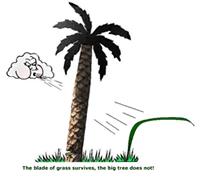
God, grant me the serenity to accept the things I cannot change, the courage to change the things I can, and the wisdom to know the difference is the beautiful 'serenity prayer' that expresses this sentiment. The emphasis in this prayer is, interestingly, on serenity, acceptance and courageousness. There is no mention of resistance.
But it is resistance that is our second nature! We tend to resist almost everything that does not conform to our likes and beliefs. When people 'misbehave' or things that we dislike happen, we find inner resistance building up. We are like the big tree. This inner resistance may be expressed outwardly or may be suppressed, depending on our habitual inclinations. Either way, our reactivity takes away our serenity and makes life difficult not only for us but also others around us.
Invariably, we believe that the cause lies outside us and our reactivity is an effect that is 'natural' and hence justifiable. There is a habitual pattern to this cause-and-effect behaviour, which we can discover if we allow ourselves to look inwards with detachment. We then notice a set of resistance patterns in us. These patterns seem to suggest that cause and effect are perhaps inextricably linked to each other. It is as though, because of our innate resistance, we attract magnetically certain kinds of 'loads', which in turn induce 'stresses' that in turn serve to strengthen our resistance and our beliefs about the external cause, in a seemingly endless cycle.
The mere witnessing of this process - which means making conscious our unconscious behaviour patterns - can help us break out of this vicious cycle. Instead of running on 'automatic', which is all-too-common, we discover a whole range of creative possibilities of dealing with every situation in life. Of course, the difficult thing is to allow witnessing, but this can be discovered through meditative practice and continued self-awareness. First, we must learn to find serenity in the absence of any storm, in our day-to-day living. Then, we can discover ways of dealing with the small storms, and then with big ones. Most of the storms lose their power to hurt us when we realise that they are imaginary. It is often like pricking an inflated balloon.
There is much to learn from the little blade of grass. Insignificant in comparison to the mighty tree, it is the blade of grass, acting without resistance that survives the severe storm.
Trans-personal Growth
Text of an invited article that appeared in the July 2006 edition of the Journal of Krishnamurti Schools
Pre-conventional, Conventional and Trans-personal Stages of Development
Recent psychological studies in human development suggest an interesting three-stage model of development: pre-conventional, conventional and trans-personal (or post-conventional). Most people successfully reach and settle into the second stage, conforming to accepted patterns of social conventions. The third stage, which reflects authentic individual maturation, is relatively rare, and is generally not supported by society.
As children, we are born innocent into a bewildering world. We are gradually conditioned into accepting the ways of the world, and we begin to derive a sense of identity and security in society, based on how well we conform to the accepted norms. This process of enculturation is so overwhelming that the maturation from the pre-conventional to the conventional takes place automatically, and is considered 'normal'. It operates in all kinds of informal and formal ways: at home, in the neighbourhood, at school, through the newspapers, TV and movies, at the workplace, and in practically all our social interactions. The indoctrination is so strong and complete that we generally end up believing in the accepted worldview and treat it as a true representation of reality. Society supports and encourages this, and in fact, blocks the stage of trans-personal growth in individuals, because this often implies breaking out of or going beyond accepted conventions.
There are many things of considerable value in the conventional world-view, but ultimately they are limiting and cannot satisfy the evolutionary quest for self-actualisation that lies dormant in every individual. The primary limitation of conventionality, as many wise people have repeatedly pointed out, is that it tends to be deadening, inauthentic and essentially unfulfilling. In a spiritual context, it is a kind of 'collective hypnosis' or 'consensus trance', from which we need to break out if we are to discover for ourselves, first-hand, authentic fulfilment, aliveness and sacredness, all of which is ever-present in the core of our being and in the universe.
Dimensions of Trans-personal Growth
Every individual has the potential for development to the trans-personal realm, and there are many dimensions in which this development is possible, not just the spiritual. Those who have advanced considerably in one dimension (say, cognitive brilliance or meditative awareness) may be at a rudimentary (pre-conventional) stage or a conventional stage of development in other dimensions, such as the interpersonal or psycho-sexual. Even within one dimension (say cognition), there is a fairly wide spectrum of areas (such as humanities and sciences), all of which cannot be developed to the same depth by a single individual. Hence, persons, who may be 'masters' in certain areas of 'specialisation', will find it difficult to understand deeply in other areas, or feel compassion.
It is not always that we have the self-awareness and humility to acknowledge: I really don't know; my understanding in this area is rudimentary. It is more common to blunder forth blissfully, talk authoritatively, and make sweeping generalisations on issues that we have little understanding or appreciation of. It is neither necessary nor possible to accomplish development at a trans-personal level in all dimensions. But, it is indeed desirable to discover the trans-personal in those areas for which one has an aptitude, to recognise one's own limitations in other areas, and to discover the space and grace to accommodate all viewpoints.
Evolutionary Progress
Growth into the trans-personal (post-conventional) level is evolutionary in nature, in the sense that it progresses from the pre-conventional and through the conventional. The progression into the trans-personal is usually triggered by a strong dissatisfaction with the conventional, and is realised after significant inner transformation that varies from person to person. The trans-personal is unconventional; but being unconventional per se does not imply being trans-personal.
The trans-personal contains within its realm the conventional and the pre-conventional. This is what enables an individual at the trans-personal stage of development to understand deeply and empathise with the conventional and the pre-conventional.
The trans-personal can often appear to be bewildering to the conventional and pre-conventional. It begins to make sense only when the individual has ripened to a stage where he or she, troubled by the limitations of the conventional, is ready to move on and transcend. It may be perhaps possible, in some rare cases, for someone at the pre-conventional level to bypass the conventional and reach the trans-personal.
Trans-personal Spirituality
Trans-personal growth in the spiritual dimension is recognised by the wisdom of the ages to be a realisation of the ultimate purpose of human life. Elements of the spiritual dimension, such as a sense of blissful oneness with Nature, do manifest in earlier stages, and in particular, in the pre-conventional stage, but there is a significant difference in the type of realisation.
During infancy, there is barely any clear awareness of a separate self, and the world is a part of oneself. The child, in fact, often refers to itself in the third person. As the child grows and begins to discover its own urges which run into conflict with the outer world, awareness of a separate ego-self begins to emerge. The fragmentation into the separate ego-self gets full-blown in the conventional stage of development. Subsequently, if and when the individual advances into the trans-personal stage, there is a growing realisation that the ego-self is but a false mental construct, and liberation lies in its dissolution.
Being in the pre-conventional stage, the child largely experiences things from its own point-of-view and is unable to comprehend or feel compassion for the needs of others, whereas in the trans-personal stage, there is a deep understanding of and compassion for others. Trans-personal spirituality is inclusive in an absolute sense, without fragmentation.
Role of Education
Education is the flowering of the individual from the pre-conventional to the trans-personal stage of development. It is a life-long endeavour.
Formal education in today's society is limited to the initial period of one's life, and its primary objective, as viewed conventionally, is to enable an individual to earn a livelihood. Conventional formal education in schools and colleges is aimed at enabling a maturation of the individual from the pre-conventional stage to the conventional stage. Individuals may subsequently, out of their own interest and initiative, unlearn and learn afresh, to progress further into the trans-personal stage. Self-education is a powerful and sure way to trans-personal growth, provided there is sincerity of purpose and a strong inner drive. One then discovers the beautiful inter-connectedness of the universe, and marvels at the way one is led onwards, through trial and error, and through teachings and insights that appear and disappear endlessly.
But there are schools where education is more enlightened, and these are schools that are either founded by great educational thinkers who have delved deeply into the trans-personal dimension, or schools that are inspired by their teachings (this includes the Krishnamurti Schools). The education here is less formal, more natural in its evolution, and certainly positions the student better for trans-personal growth. However, the conventional stage of development cannot be bypassed or wished away. Students must also be prepared to understand and meet the ways of the world; otherwise, the transition from such a school to the real world can be extremely difficult and bewildering. Hopefully, the trans-personal flavour of the teachings will sustain in the individual through the turbulent period of dealing with the existential problems of the real world, and make it possible to be in the world, but not of it.
Freedom or Bondage?
However, it is not easy for any system of education or any organisational set-up to realise trans-personal wisdom. The very nature of an organisation, and the fact that it is set up to promote or propagate some value system or teaching, no matter how noble or evolved, pushes it into a conventional mode. Although the conventions adopted may be completely different from others, and far more enlightened, they can, and often do, end up as conventions. There is the danger of becoming institutionalised, of the original vision losing its vibrancy and becoming static and authoritarian. And this is perhaps as true of Krishnamurti Schools as any others. This is something that the teachers and administrators need to be aware of and try to guard against.
Perhaps in the Krishnamurti Schools the teachings have truly resulted in a fundamental change in attitude. But is this the radical transformation that Krishnamurti was pointing at, something that was clearly reflected in his own life? Or, over the years, has there been a plateau in the transformation process, and instead of freedom from the known (which includes the teachings or the vision), there is bondage? In which case, is there not a need to till the soil of the psyche again and again, to root out the weeds of dead insights, and to allow for the fresh and the new to take birth and flower? The fresh and the new may spring from within one or be inspired from outside, but this is possible only if the mind is open and free from enculturation and bondage to any teaching. Enculturation of the mind manifests in going around repeatedly through the same old familiar grooves of thought and enquiry, without breaking through to that which is beyond thought.
It is not easy for individuals within a system to see whether or not they are falling into the 'consensus trance' that is characteristic of the conventional realm, unless they are very alert and self-aware. Typical tell-tale signs are a cult-like adherence to conventions, in terms of ideology, style of discourse and even choice of words that seem to be an echo of the original founder. These may be good conventions, but their 'goodness' is suspect when they tend to be binding. The beauty about authentic trans-personal realisation is that it cannot help but manifest in original, spontaneous and creative expression, which is not cultivated, but is born from first-hand living experience.
Century after century, and sage after sage have pointed to the trans-personal realm. It is that which they are all pointing at which is of vital importance, not the particular finger (teaching) that points.
Remaining Awake to Our Major Purpose
Imagine Krishnamurti to be reborn, unknown to all, including himself! Imagine him as a student in one of the present-day Krishnamurti schools.
How would such a person respond to the 'teachings' that are encoded in the structuring and running of the school? Would he or she simply accept and follow them? Or perhaps, would he or she rebel, and brilliantly blaze an original trail to the trans-personal? More importantly, how would the teachers and school authorities respond to the student's behaviour? Would they have the wisdom to recognise the potential emergence of the trans-personal in new forms? Will they do their best to encourage and facilitate this emergence? Or, will they, acting in good faith, do their best to thwart it and 'correct' it? Are these not crucial questions to ponder over?
The exceptional boys and girls in our schools and colleges may evolve to the trans-personal, with, or in spite of, our help. Our task in education is to facilitate this in as many individuals and in as many ways as possible. To make this possible, we need to make our own journey to the trans-personal the major definite purpose of our lives and allow it to unfold in ways that are not pre-determined or conformist. We need to be awake and alert to entrapments that lull us into a false sense of security.
We will do well to assess whether our current stage of development is authentically trans-personal or merely the conventional in a different guise. Our hearts will reveal the truth and guide us, if we would but let them.
Mind Control
Text of an article that appeared in the April 2010 edition of the IIT Madras magazine Reflections
When it's hot, we switch on the fan,
When not needed, we switch it off.
When it's dark, we switch on the light,
When not needed, we switch it off.
We switch things off when they are not needed,
To conserve power, to avoid waste and be efficient.
We switch things off because we can switch them off.
We are their master, we can decide: on or off.
But there are some things we cannot switch off.
We cannot switch off our minds.
They operate relentlessly, whether we like it or not.
We like it, when they serve our purpose, which is rare.
Most often, they serve no purpose.
Mental activity is just a lot of noise.
Mental noise interferes even in the best of times,
When we try to enter into relaxed concentration.
Ever tasted fully every bite of your favourite meal?
Or listened to every note of your favourite music?
Within a few moments into every such activity,
The mind slips away into needless distraction.
And yet we believe we own and run our minds, our thoughts,
When in truth we are not their masters, we are their slaves.
They draw us away from the task at hand, the present reality,
Into an unreal world of fantasy, into the future or the past.
We are at the mercy of thoughts and emotions,
It is they who run, and often ruin, our lives.
As when we get confused or enraged
And say and do things we regret later.
Or when we are consumed by desire
And cannot rest till the craving is fed.
Or when we fret and worry endlessly,
Unable to concentrate and plan skilfully.
Or when we are bored or feel lethargic,
And the mind engages in mindless 'surfing'.
It's like a computer that keeps running,
Scorning our best efforts to switch it off.
So many hidden programs run in the background,
Draining off our attention, energy and efficiency.
No wonder, at times when we really need to focus,
Distractions get the better of our concentration.
And at crucial times, the system just 'hangs',
Paralyzing our efforts to respond appropriately.
Why allow the uncontrolled mind to govern our lives this way?
Why be victims of random thoughts and conditioned reactions?
Look for ways of taming this mental noise,
Of gaining control over the on-off switch.
And of moving consciously in the 'right' direction,
Rather than operating helplessly on 'auto-pilot'.
Are there such ways? Sure, there are!
Though not yet in our curriculum.
Modern education just gets us a livelihood.
It does not teach us how to live.
It takes wisdom to realize that we cannot be happy,
Pursuing never-ending desires for money and fame.
It takes courage to pause in the rat race, to question
And to see that we need a radical change in attitude.
And it takes skills to nurture a meditative mind
That is anchored in stillness, harmony and wisdom.
Such a mind acts as a moral compass that points clearly
To what is wholesome and skilful, and what is not.
It enables us to watch the rising and passing of every experience,
Not getting trapped and ego-identified, and yet responding skilfully.
May our education expand to include this art of wise living,
May we all awaken and stop sleepwalking through life!
Evolution and Enlightenment
Exploring "Self-Awareness" with the Youth
Reflections of a student-teacher at IIT Madras
Text of an invited article that appeared in the Sept. 2019 edition of 'Contour', the magazine of the Civil Engineering Association of IIT Madras
It's been 44 years since I set foot on this beautiful campus at IIT Madras. It seems like yesterday. Time passes by swiftly indeed. Although there have been many changes at IITM over the years, in some sense, I feel nothing really has changed.
The campus is still as fresh and beautiful as it was when I first saw it. I am still wonder-struck seeing the spotted deer and black buck, the monkeys, the birds, the butterflies, the giant banyan trees, the green foliage everywhere, the wildflowers, the squirrels,... I am awed by the rhythmic orchestra of crickets breaking the silence of the forest at night and early morning. There is something powerful and alluring in this natural beauty and stillness; it just blows your mind away. I love especially the quiet open spaces and less-trodden paths, where it is easy to slip into timeless wonder - simply walking around carefree, enjoying the freshness, the freedom, the sheer beauty and the sense of oneness with Nature, our greatest teacher and loving friend. I deem it a great privilege and blessing to have lived, studied and worked in these serene sylvan surroundings.
This freshness and ever-youthful vibrancy can also be seen in the new students who come to join every year. Batch after batch, students keep coming and going, while we teachers remain here, renewed and replenished by their freshness and youthful energy. Time stands still. Like IITM today, I too feel 61 years young.
Of course, there's a flip side to this perspective. But if that's what we choose to focus on, we are likely to age and wear out quickly. Even students know what this feels like. You come in, filled with eager expectations, with a sparkle in your eye, but even before the first quiz is over, you know how heaven can turn into hell. During the course of the two or four / five years of IITM life as a student, the burden of ungratified desires in the academic rat race (and subsequent placement race) can wear you down - unless you are fortunate to stay on top, or have excelled in other creative pursuits, or have somehow learnt the rare art of living happily, regardless of how external circumstances play out.
The academic rat race is a reality for the teacher too, faced with the increasing challenge of "publish or perish". You come in with great expectations of interacting with the brightest minds in the country in teaching and research. The results of the first quiz can come as much a shock to the teacher (who sets a challenging question paper) as to the student. Perhaps the biggest challenge for the teacher of large BTech classes is the harsh reality that the majority are barely interested in civil engineering.
Were things significantly different four decades ago? Not really! Except, perhaps, for the fact that we were somehow less stressed, having more time for leisure, reading and fun during our 5-year BTech programme (with no digital addictions)! The majority of my classmates (and batch-mates) have now little to do with their core engineering disciplines. They have followed varied career paths, and many have excelled in their chosen vocations. I am amazed at the diversity of their disciplines and locations (spread all over the world), and especially the range of topics they speak so knowledgeably about (in our Whatsapp group). Almost everyone in the batch looks back nostalgically on the times we shared at IITM - the wonderful hostel life, the daily discussions in the hostel mess, interesting classroom incidents, the sports, literary and cultural activities, the OAT movies, the lovely hostel day functions (also attended by our teachers and their families, whom we would cordially invite - unlike present times)... Whenever someone in our batch wins some award, or IITM gets some recognition, we all feel elevated. We are also proud of the fact that the current Director of IITM belongs to our batch.
Students may find it hard to visualise that we teachers were once like you (and deep inside, we still are). Teachers will also do well to recall that we are made of the same stuff as students, who have the same potential - to excel in whatever they really want. I distinctly remember being open to many options in the final years of my BTech programme. Indeed, I never thought that I would end up as a teacher. Throughout my education, I simply worked on one principle: to enjoy, and to excel in, whatever I was called upon to learn. Humanities was as interesting to me at school as the Sciences, and I was tempted to pursue Literature and be a writer or journalist. But I also found it very interesting and challenging to solve the problems posed in JEE question papers (without any coaching), and as luck would have it, I ended up at IITM. Many years later, I realised my teenage wish of studying English Literature, by taking up a post-graduate course at Mysore University. Inadvertently, I also ended up realising my wish to be a writer, by writing a few books - on structural engineering topics (Reinforced concrete design, Structural analysis, Advanced structural analysis) and on life in general (Stop sleepwalking through life! and Spirituality at work).
It was only after I took up a job as a structural designer at New Delhi, immediately after graduation, that I fell in love with structural engineering. I have remained loyal to my love since then. I even ventured into business in structural engineering consultancy, setting up my own company - but soon realised that business was not my cup of tea. Being your own boss can be thrilling initially, until you discover that the clients are the real boss, demanding that you meet near-impossible deadlines. Working long hours is not a problem when you are young and unmarried, but what I found myself totally unprepared for was the ethical challenge of having to pay bribes to receive rightful payments in public sector projects. I knew something was fundamentally wrong, and found myself confronted by a key question I had never asked in the past, What is the purpose of my life? My restless search for answers to this query eventually took me to the Himalayas...
To cut a long story short, I ended up in academics, specialising in structural engineering. When I took my first class as a teacher, it felt like a fish taking to water. I loved it. It felt wonderful. But apparently, my classes were not so wonderful as to bring any significant change to the prevailing system. Students continued to drift from civil engineering into other pastures (primarily because of the 'pay package'). So, how do I continue enjoying my role as a teacher? How do I add value to students, so that they benefit in some significant manner from our classroom interactions?
These are the challenges all teachers keep facing. It is not for me to comment on the extent to which I may have succeeded or failed; that is for the students to decide. I wish them well, and hope that I have inspired them in some way. Some ten years ago, I realised that there were some fundamental missing elements in our education, related to the very questions I faced in my own life. This led to the launching of the first 'GN' (general) category (free elective) course at IITM on Self Awareness, open to all students in the Institute. It quickly became popular, and as students wanted to explore further, a second course, titled Integral Karmayoga, was launched. These courses aim at inner development and authentic living, including helping the student discover one's inherent aptitude and potential, as well as being able to deal creatively with the various challenges that life throws at us. Most important of all, the courses help us realise that the enduring happiness we seek is waiting to be discovered within us as a way of being, and not as occasional experiences dependent on external circumstance.
It's time to wind up this article. What is my concluding message to our dear students?
Find out what you're good at (your talents), what you love doing (you don't feel the time pass), what you have a deep inner calling for, and where your contributions can help transform society - and just go all out and walk that path. Hopefully, it will be in the domain of civil engineering - the branch you are married to. We have plenty of challenges in civil engineering: infrastructure, housing, transportation, water resources, sanitation, pollution control, etc., that need the best brains, hearts and hands to work on. Isn't that precisely what was expected from the IITs when they were set up? Our country needs you!
But, of course, you are also given the freedom to choose as you please! May you find fulfilment wherever you go, in whatever you do!